
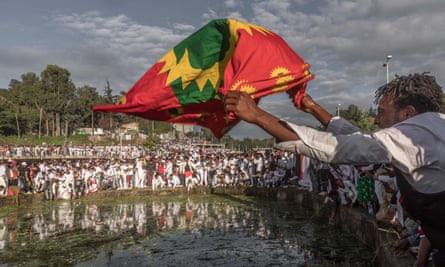
Ethiopia’s Nobel peace prize-winning prime minister Abiy Ahmed has been urged to investigate allegations that state security forces have committed a raft of serious human rights abuses including torture and unlawful killings since he came to power in 2018.
According to a report by Amnesty International, published on Friday, Ethiopia’s military and police in its two most populous regions arbitrarily detained more than 10,000 people, summarily evicted whole families from their homes – some of which were burnt and destroyed – and in some cases were complicit in inter-communal violence targeting minorities.
Federal authorities have not responded to the report, which focuses on the period between January and December 2019 in the regions of Amhara and Oromia.
“Given the gravity and the duration [of the period in which abuses were reported] I cannot believe top officials are not aware of what was happening,” the report’s author, Fisseha Tekle, told the Guardian. “And if they are not then it is a dereliction of duty.”
What Bolsonaro said as Brazil’s coronavirus cases climbed
In Oromia, security forces are waging a counter-insurgency campaign against rebels from the Oromo Liberation Army (OLA), an armed guerrilla movement demanding more autonomy for Oromos, which returned from exile in 2018 after Abiy removed it from Ethiopia’s list of terrorist organisations.
The move was part of a package of democratic reforms which won the prime minister widespread acclaim and, along with making peace with neighbouring Eritrea, secured him the Nobel peace prize last year. Shortly after becoming prime minister Abiy also confessed that security officials had in the past committed torture, and promised to ensure the sector was fully accountable in the future.
But the OLA has since returned to armed conflict, and accuses the government of failing to deliver its promises of more democracy and self-rule for Oromos.
Fighting in western and southern parts of Oromia has involved targeted killings of local officials and community leaders and what the UN has described as “serious human rights violations”. In Oromia’s Guji district the unrest had driven 80,000 people from their homes by the start of this year.
Amnesty said it had a list of 39 people suspected of supporting the OLA who had been unlawfully executed in two parts of Guji since January 2019. It also said that on a single day in December 2018, soldiers from the federal military killed 13 people in the town of Finchawa in West Guji. One of those killed was an old woman selling milk on the street, according to an eyewitness who spoke to Amnesty.
Security forces are estimated to have detained more than 10,000 men and women suspected of supporting or working for the OLA, among other abuses documented by the organisation.
Source: Ethiopia’s security forces accused of torture, evictions and killings – report


Recent Comments